Two brain technologies to watch, and what families should know now
Psychiatrists Eugene Rubin and Charles Zorumski of Washington University School of Medicine wrote in Psychology Today about two technologies they believe could move psychiatry forward. The first is low-intensity focused ultrasound, a noninvasive way to stimulate brain structures that sit too deep for TMS to reach well, without the surgery that deep brain stimulation requires. The second is longitudinal precision functional mapping: brain scans repeated over time that chart one person’s own brain circuits as their symptoms change, rather than relying on averages across many people.
Here’s my take for families:
- It’s not available yet. Focused ultrasound isn’t approved for psychiatric use. The authors say its safety and effectiveness still have to be shown, and it’s not yet clear whether it will outperform TMS. If a clinic offers it to your loved one today, ask whether it’s part of a research study.
- The big idea is one we already know. Precision mapping starts from the fact that circuits differ from person to person. Families have always known that no two people’s illness looks the same. It’s encouraging to see research catching up.
- It’s aimed at the hardest cases. The authors don’t name schizophrenia or bipolar disorder specifically. They write about severe illnesses that haven’t responded to medication or therapy, which is where many of our families are, and why this is worth following.
- People still matter most. The line I appreciated most comes near the end. Even if targeting deep brain circuits reduces symptoms, the authors say psychosocial support will still be needed to help people return to family, social and work life. No device replaces that part, and families are a big piece of it.
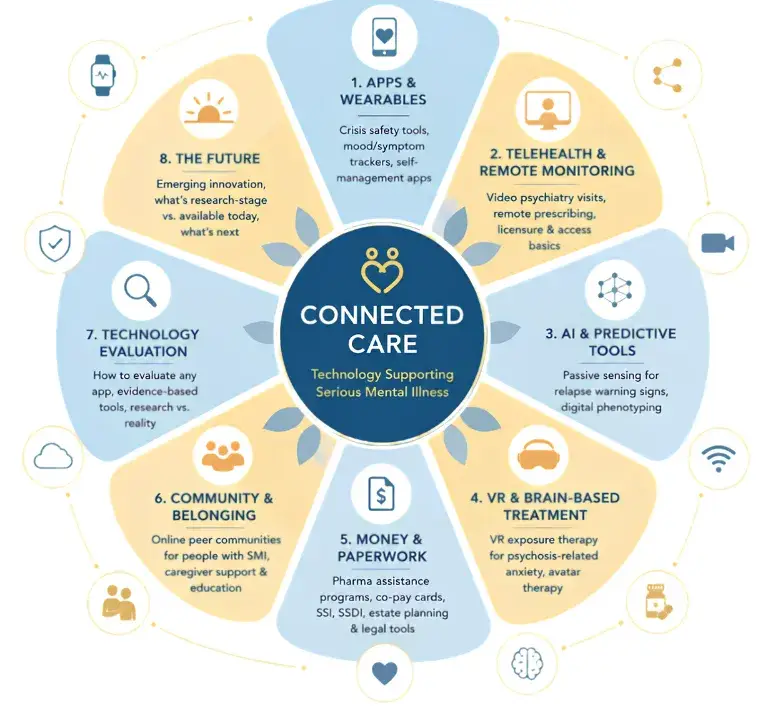
If you’d like to understand the brain-based treatments available today, including TMS and ECT, Chapters 6 and 7 of Connected Care walk through them.