Three early-stage technologies this week: one aimed at voices, one at the social symptoms medication doesn’t reach, and one that is still years from patients.
Ultrasound and the voices that medication doesn’t quiet
If your loved one still hears voices on medication, you may see headlines this week saying ultrasound “silenced” them. Here is what actually happened. Researchers at UCSF used a wearable ultrasound headband from Attune Neurosciences to reach deep brain areas linked to hallucinations. In three people who had lived with schizophrenia for an average of 26 years, the voices dropped by more than half right after treatment, with no serious side effects.
The effect wore off within a week, and three people is a starting point, not proof. UCSF is now running a follow-up study of about 12 adults with five daily sessions, compared against a sham treatment. Focused ultrasound is not FDA-cleared for any psychiatric use. If you are interested, the honest next step is to ask your psychiatrist about research trials, and to check the trial listing for whether it is enrolling.
An app for the social side of schizophrenia
Antipsychotics can quiet hallucinations and delusions, but they do little for social cognition: reading faces, picking up on tone, understanding what another person means. Those are often the skills that make it hard to keep a friend or a job. In South Korea, Bukwang Pharmaceutical, Samsung Medical Center and the startup Blue Signum signed an agreement on October 15 to develop Affectus, a software-based digital therapeutic that trains social cognition in people with schizophrenia.
An early exploratory trial is already underway at Samsung Medical Center; the agreement covers the larger trials and regulatory approval still to come. Affectus is not available in the U.S. But it joins Motivista, recently cleared by the FDA for negative symptoms, in a growing group of digital treatments aimed at the parts of schizophrenia that medication doesn’t reach.
A brain chip that reads how brain regions talk to each other
Engineers at EPFL in Switzerland, led by Mahsa Shoaran, built LogSync, a tiny implantable chip that tracks how different brain regions communicate and can trigger stimulation when it detects a particular mental state. It runs on under 200 microwatts, little enough for a device that stays in the body. Shoaran’s view is that “psychiatric disorders arise more from disruptions in communication between brain regions,” rather than from one area alone.
So far it has been tested on brain recordings from earlier human studies and in rats at the University of Minnesota, not in patients. The researchers have in mind severe depression, PTSD and OCD rather than schizophrenia or bipolar disorder, and they say it needs more development before clinical use. It’s worth knowing about as a sign of where adaptive brain stimulation is headed, years from now, not as an option today.
Until next time
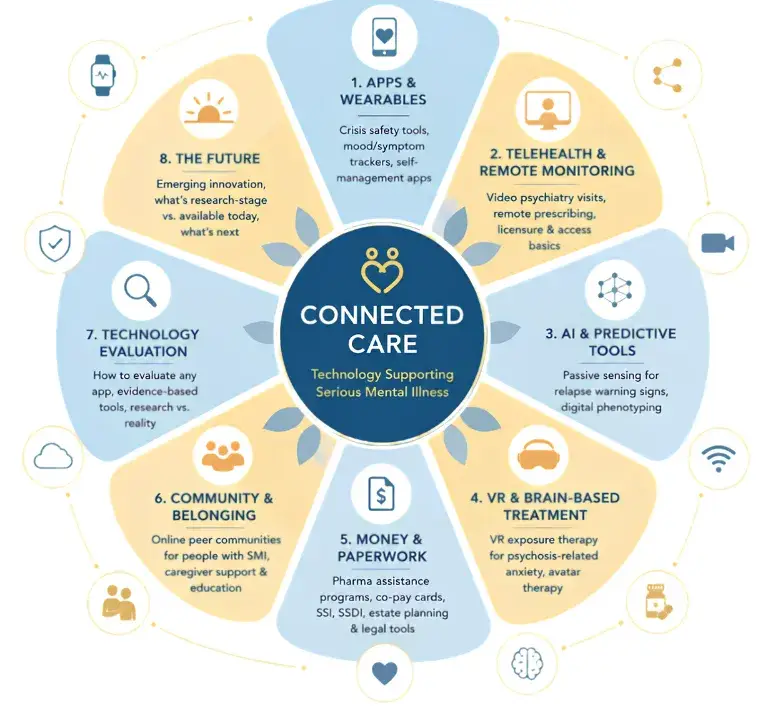
None of these three is something your family can use today. Each is a reason to keep asking your loved one’s care team what’s coming, and what trials they know about. If you want the full map of what is available now, from apps to telehealth to financial help, it’s in my book, Connected Care.