Recently NAMI — the largest grassroots mental health organization in the country — announced something worth every caregiver’s attention. They’re building independent benchmarks to evaluate how AI chatbots respond when people turn to them for mental health support. They’re partnering with Dr. John Torous, director of Digital Psychiatry at Beth Israel Deaconess Medical Center, to test these tools for safety, accuracy, and cultural sensitivity.
Their reasoning is simple, and I think it’s right: AI is already part of how people look for mental health information, whether anyone planned for that or not. A recent NAMI/Ipsos survey found that 12% of adults are likely to use an AI chatbot for mental health care in the next six months. People are not waiting for permission. They’re already doing it. NAMI’s position is that since this is already happening, the responsible move is to bring clarity to it — not to pretend it isn’t occurring, and not to endorse it either.
I want to be very clear about something: Connected Care does not disagree with any part of this. If anything, reading NAMI’s announcement felt like reading a description of exactly what I was trying to do in my own book, from a different angle.
Where We Land in the Same Place
NAMI’s bottom line is this: AI does not represent a substitute for clinical care, for any age group, for any condition. They will not endorse AI for treatment. Their benchmarks exist to help people understand what these tools can and cannot safely do — not to suggest AI is ready to stand in for a person who’s trained for this work.
Connected Care reaches the identical conclusion. In the chapter on AI and predictive technology, I wrote that AI’s most important role in serious mental illness care isn’t replacing clinicians — it’s catching what they can’t see between appointments. The small, accumulating shifts in sleep, movement, and communication that often happen days or weeks before a crisis becomes visible. That’s a meaningfully different job than diagnosis or treatment, and it’s a distinction I tried to make as clearly as I could throughout the book. AI is an assistant. It’s an extra set of eyes. It is never a substitute for the people who actually provide care.
We also land in the same place on two other fronts that I think don’t get enough attention:
Bias and equity are not a footnote. NAMI’s benchmarks specifically test whether AI tools respond respectfully across cultures and lived experiences. I spent real time in Connected Care on this same concern — specifically the risk that if an AI model is trained on data that underrepresents marginalized populations, it will systematically misclassify the people most likely to already face barriers in the mental health system. I also wrote about something I think is under-discussed: the risk of over-alerting in communities that already experience over-policing and coercive care. A relapse-prediction tool that’s too quick to flag someone as high-risk isn’t a neutral inconvenience in every community. In some, it can mean an unwanted welfare check or a worse outcome entirely.
Consent and data ownership have to be ongoing, not a one-time checkbox. This is especially complicated in serious mental illness, where someone might be under guardianship or have fluctuating insight into their own condition at different points. NAMI’s framework checks whether tools avoid implying privacy protections they don’t actually have. My book goes further into the mechanics — who legally owns behavioral data collected from a phone or wearable, how long it’s stored, and what happens when “always on” monitoring quietly becomes the default instead of a deliberate choice someone made.
Where “Connected Care” Goes a Layer Deeper
Here’s the most important distinction, and it’s not a disagreement — it’s a difference in where each of us is looking.
NAMI’s current work is focused on conversational AI: the chatbot a person opens when they’re looking for support, information, or someone to talk to. That’s an enormous and urgent piece of this conversation, and I’m genuinely glad a credible, science-led organization is building real benchmarks for it.
Connected Care spends most of its time on a different layer of AI — one that’s already embedded inside psychiatric care for serious mental illness specifically, often invisibly, whether or not a family has ever heard the words “artificial intelligence” in a doctor’s office. This includes:
- Relapse prediction systems that analyze passive smartphone data — GPS patterns, sleep disruption, communication frequency, even voice changes — to flag warning signs before a crisis becomes obvious. Real systems, like Vanderbilt’s VSAIL model, are already running inside electronic health records today.
- Clinical decision support that helps care teams prioritize who needs outreach first, in systems where time and staffing are always limited.
- Pharmacogenomic tools that use genetic information to help reduce the trial-and-error of psychiatric medication dosing — already closer to routine practice than most families realize.
- Natural language processing that can audit clinical notes for bias in how different patients are documented and treated.
None of this is “AI as a chatbot you talk to.” It’s AI as infrastructure, quietly shaping decisions that already affect real families navigating schizophrenia, bipolar disorder, and related conditions. I think families deserve to know this layer exists too — not just the conversational AI layer NAMI’s benchmarks will illuminate, but the clinical and predictive AI that’s already running in the background of their loved one’s care.
Two Organizations, Different Rooms, Same House
I don’t think of this as two competing views on AI and mental health. We have the same non-negotiable bottom line: AI can help. It cannot replace the people who actually care for you. Equity and consent are not optional extras — they’re the test any tool has to pass before it earns trust.
NAMI is building the framework for evaluating the AI tools showing up in everyday conversation. Connected Care is the guide for the AI already showing up in the clinical and predictive side of serious mental illness care — what’s real today, what’s still experimental, and what questions to ask your care team before trusting any of it with something this important.
If your family is navigating this right now, you deserve both rooms lit up, not just one.
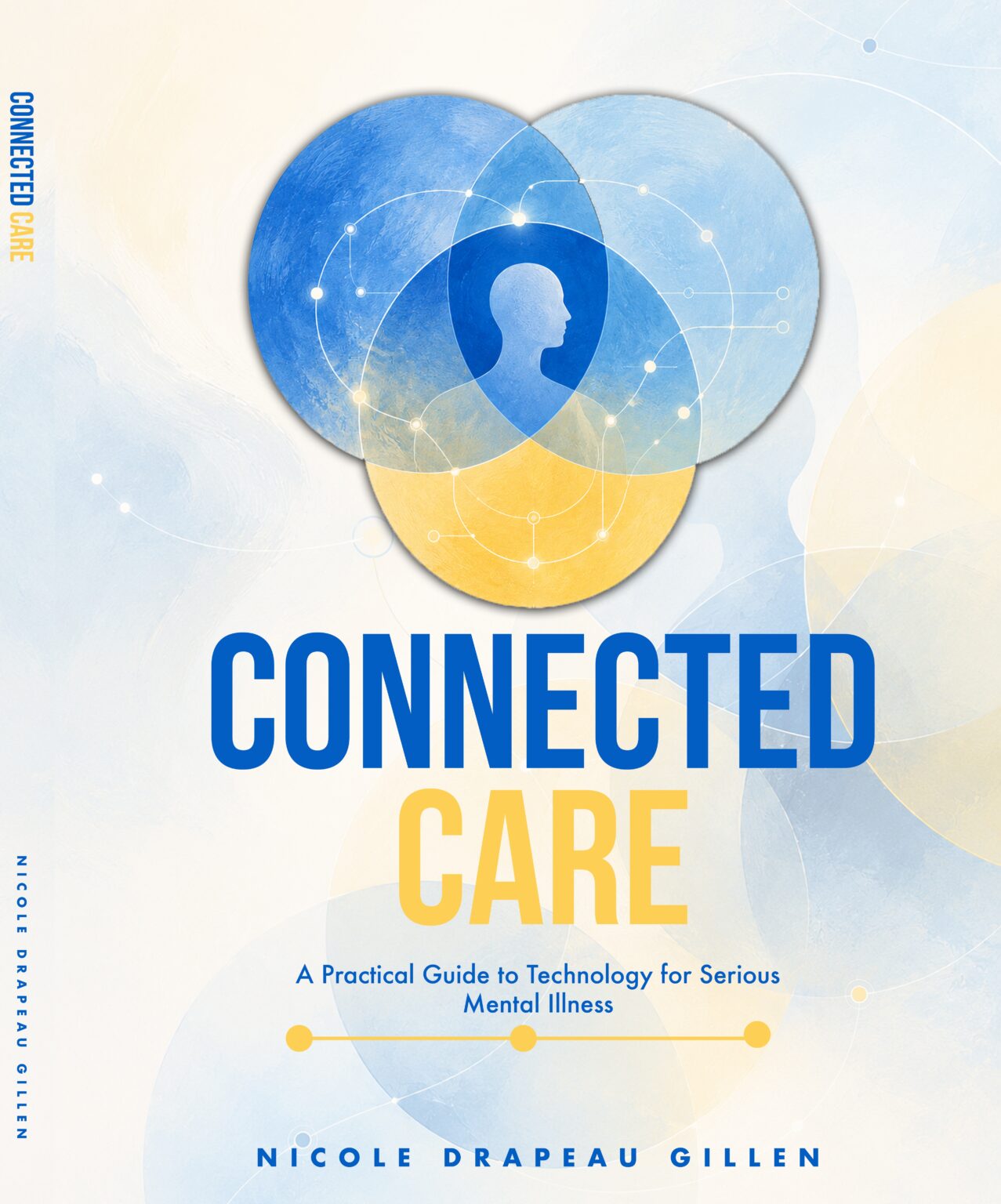
Connected Care: A Practical Guide to Technology for Serious Mental Illness is available now on Amazon. Learn more at resourcesforsmi.com.

Great idea, just a couple of days ago I was delving into this topic!